Search tyres








































































23 Mar 2026
Tyre tips, deals and updates in your inbox
Burning Rubber: The Iran conflict’s impact on Australian tyre prices
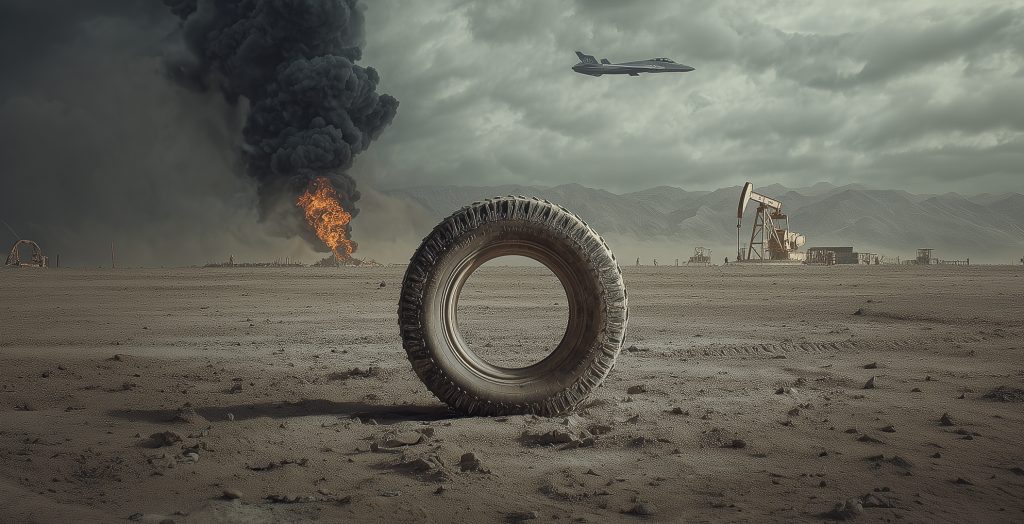
Four weeks into the Iran conflict and the effective disruption of the Strait of Hormuz, most Australians are feeling the impact in the most visible way possible: at the bowser. Fuel prices have surged, headlines are dominated by oil, and the geopolitical narrative feels familiar.
But beneath that surface sits a quieter, slower-moving shock—one that is far more structural and, in many ways, longer lasting.
It’s happening in the tyre market.
And for us in Australia, that matters more than most people realise.
The invisible link: why oil is really a tyre story
It’s easy to think of tyres as “rubber products,” and therefore only loosely connected to oil. In reality, modern tyres are deeply entangled with petroleum.
Oil sits inside tyre production in three critical ways:
- As a raw material source: Synthetic rubbers like SBR and butadiene rubber are derived from petrochemicals.
- As a reinforcing system: Carbon black—essential for durability and wear—is produced from heavy oil feedstocks.
- As a compounding ingredient: Process oils are blended into tyre compounds to control flexibility, grip, and manufacturability.
In practical terms, oil is not just an input—it is a foundation.
Which means when oil supply is disrupted, tyres don’t just get more expensive. Their entire production ecosystem tightens.
The chokepoint: why Hormuz matters more than headlines suggest
The Strait of Hormuz is not just another geopolitical flashpoint. It is the single most important artery in global energy trade, with roughly 20% of the world’s oil passing through it.
For China—the world’s largest tyre manufacturer—the exposure is acute:
- ~40–50% of its crude imports transit Hormuz
- A significant share of its discounted Iranian oil supply is now politically contingent
- Multiple supplier nations (Saudi Arabia, Iraq, UAE, Kuwait) are affected simultaneously
This is not a single-source disruption. It is a systemic supply shock.
And crucially, it hits China first.
China’s response: stabilise internally, tighten globally
Faced with constrained crude supply and falling refinery throughput, China has made a predictable—but globally consequential—decision:
It has kept oil and oil-derived products at home.
This includes:
- Restricting exports of diesel and petrol
- Limiting petrochemical feedstock exports
- Cutting refinery runs in response to crude shortages
From China’s perspective, this is rational. It protects domestic industry, stabilises energy availability, and avoids internal inflation.
But globally, it has a very different effect.
China is not just a consumer of oil—it is a processing hub for the world:
- A major exporter of synthetic rubber inputs
- A dominant producer of tyres
- A key supplier of intermediate petrochemicals
When China tightens exports, the global market loses not just supply—but processing capacity.
Australia’s position: downstream and dependent
This is where the global story becomes distinctly local.
Australia no longer manufactures tyres at scale. We are, almost entirely, an import market—and a highly concentrated one at that.
- We import around 25–26 million tyres each year
- Approximately 50–52% of all tyres entering Australia originate from China
- The vast majority of the remainder comes from Asia, primarily:
- Thailand (~15–20%)
- Vietnam (rapidly growing and increasingly significant)
- South Korea and Japan (smaller but important premium segments)
In practical terms:
More than half of the tyres fitted to Australian vehicles are made in China.
Nearly all the rest are made within the same regional supply chain.
This matters enormously.
Because when China restricts exports, it doesn’t just shift global pricing—it directly constrains the supply available to us.
The supply chain shock: from crude to consumer
To understand what happens next, you need to follow the chain:
1. Crude disruption
Less oil flows through Hormuz → China receives less feedstock
2. Refining contraction
Chinese refineries reduce output → fewer fuels and petrochemicals produced
3. Export restriction
China prioritises domestic supply → fewer products reach global markets
4. Petrochemical squeeze
Synthetic rubber, carbon black, and oils tighten globally
5. Manufacturing pressure
Tyre factories face higher costs and constrained inputs
6. Australian impact
Higher import costs, longer lead times, and reduced availability
This is not a linear effect. It is multiplicative.
Each stage amplifies the one before it.
A historical echo: 1973 and the lessons we forgot
This is not the first time oil has disrupted the tyre market.
During the 1973 oil crisis, Australian consumers experienced:
- Sharp increases in tyre prices
- Material shortages
- Reduced availability of certain tyre types
- Behavioural shifts—drivers delaying replacement and stretching tyre life
But there is a crucial difference.
In 1973, the shock was largely upstream—a crude oil embargo.
Today’s crisis is:
- Upstream (oil supply disruption)
- Midstream (refining and petrochemical constraints)
- Downstream (China restricting exports)
This makes it more complex—and potentially more persistent.
Where 1973 created price spikes, today’s environment is creating systemic tightness across the entire value chain.
The tyre market response: what we’re already seeing
Four weeks in, early indicators are emerging:
Rising input costs
Synthetic rubber and carbon black prices are climbing as feedstocks tighten.
Freight pressure
Higher fuel costs and disrupted shipping lanes are increasing landed costs.
Supplier caution
- Holding inventory
- Delaying shipments
- Repricing forward contracts
Early price movement
Wholesale tyre prices are already edging upward, particularly in passenger, SUV and light truck segments.
The consumer reality: what happens next
For the average Australian tyre consumer, the effects will not be immediate—but they will be inevitable.
Tyres are a lagging indicator.
Unlike fuel, which reprices daily, tyres move through inventory cycles, shipping delays and wholesale contracts.
The real impact is likely to hit 4–8 weeks after the initial shock.
Which places Australian consumers right on the cusp of the price wave now.
The critical question: how much will tyres increase?
To answer this, we need to combine three forces:
- Oil price increase: +5–8%
- China export restrictions: +5–10%
- Freight and logistics: +3–5%
Total expected tyre price increase: 12% to 20%
What this means in real terms
- $800 set → $900–$960
- $1,200 set → $1,350–$1,440
If the conflict continues:
- Prices may exceed 20–25%
- Availability may become the bigger issue
Scarcity vs price: the bigger risk
The more interesting—and less discussed—risk is not price.
It is availability.
As supply tightens:
- Certain sizes may become difficult to source
- Budget segments may be hit hardest
- Lead times may extend significantly
This drives behavioural change—earlier purchasing, brand substitution, and reduced price sensitivity—which further reinforces price pressure.
The broader insight: this is not a temporary spike
This is not just an oil price increase.
It is:
- A geopolitical shock
- An energy disruption
- Amplified by China’s industrial policy
- Transmitted through global manufacturing supply chains
- Landing in an import-dependent market—like ours
And when these forces combine, the effects tend to linger.
Final word
The Iran conflict has not just raised oil prices.
It has exposed the hidden architecture of global manufacturing—and Australia’s position within it.
For tyres, the story is clear:
- Oil underpins the material
- China underpins the supply
- Asia underpins the manufacturing base
- And Australia sits at the receiving end
If the conflict continues for another four weeks, we should expect tyre prices to rise by 12–20%, with availability becoming the bigger constraint.
Fuel may dominate the headlines.
But for Australian drivers, it’s what’s touching the road that may soon cost more—and be harder to find.
Subscribe to our newsletter








 Great News
 Please note